
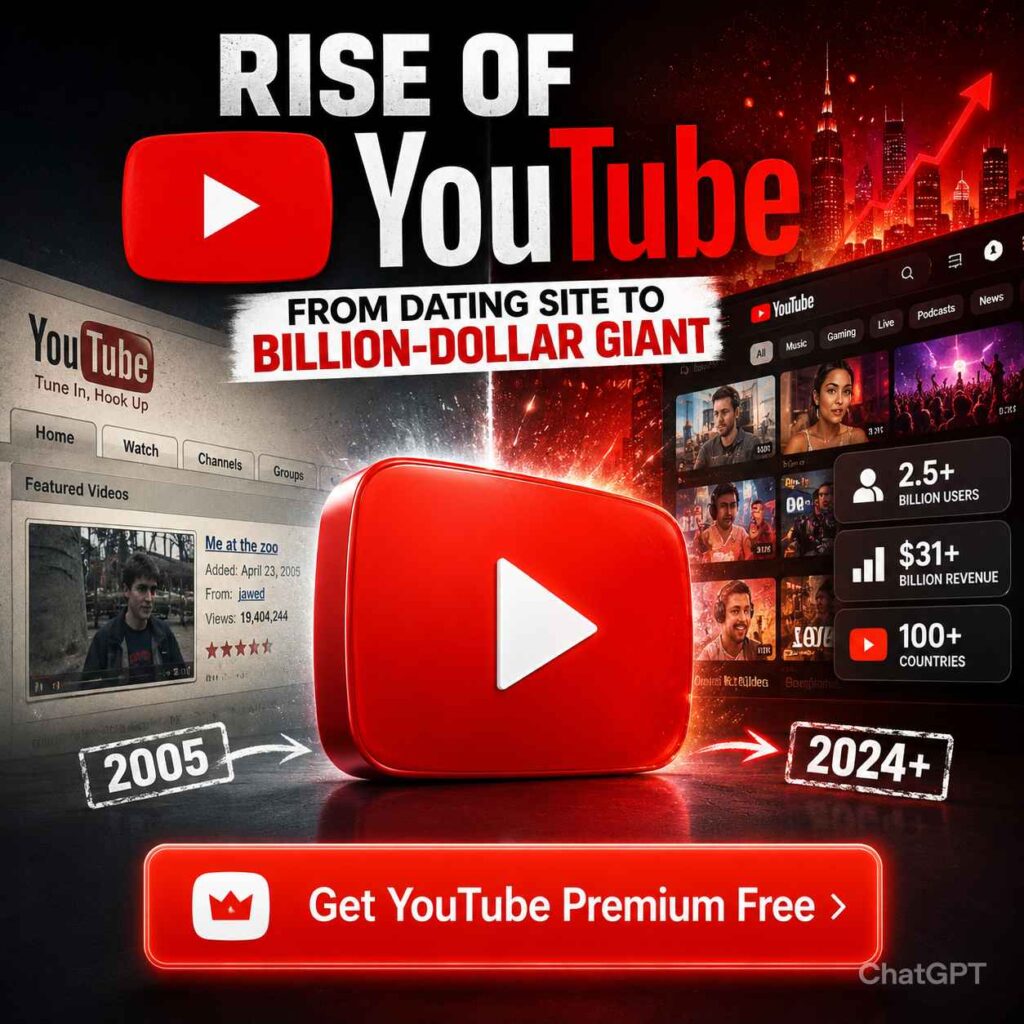
Most people know YouTube as the world’s largest video platform. Few know it was born as a complete failure — a video dating site that nobody wanted to use.This is the real, raw, and inspiring journey of YouTube: from a San Francisco garage idea to a multi-trillion-dollar force that redefined human communication.
The Valentine’s Day Idea That Flopped
- On February 14, 2005 (Valentine’s Day), Chad Hurley registered the YouTube.com domain.
- The original concept: “Tune In, Hook Up” — a video dating platform where people would upload short clips introducing themselves and describing their ideal partner.
- Founders (all ex-PayPal employees): Chad Hurley (design), Steve Chen (engineering), and Jawed Karim (programming).
- They even tried bribing people — posting Craigslist ads offering $20 to women who uploaded dating videos. Almost nobody showed up. theguardian.com
The dating site lasted barely a week before the founders realized users simply weren’t interested in broadcasting their romantic lives.Key Pivot Moment: Instead of forcing the dating idea, they asked: “Why not let users decide what the platform is for?” This user-first philosophy became YouTube’s greatest strength.The Humble Birth: “Me at the Zoo”
- On April 23, 2005, Jawed Karim uploaded the first video ever: “Me at the zoo” — an 18-second clip of him standing in front of elephants at the San Diego Zoo.
- The video is still live today and has accumulated hundreds of millions of views.
- Early technical limits were brutal: videos capped at 100 MB and roughly 30 seconds long.
Explosive Growth & Smart Decisions
- By mid-2005, YouTube was exploding because of its dead-simple interface — no tech skills required.
- Early viral hits included the Nike Ronaldinho ad and user-generated funny clips.
- Unlike competitors, YouTube focused on instant playback and easy sharing via links.
- December 15, 2005: Official public launch.
The Google Acquisition That Changed Everything
- In just 18 months, Google bought YouTube for $1.65 billion in stock (October/November 2006).
- Many analysts called it overpriced and risky due to massive copyright problems and bandwidth costs.
- Google’s move proved genius. They kept YouTube’s independent brand and community spirit while providing world-class infrastructure.
Lesser-Known Fascinating Facts
- The office was above a pizzeria in San Mateo, California.
- Founders initially uploaded random videos (including airport plane footage) just to test the site.
- YouTube’s early slogan briefly became “Your Digital Video Repository.”
- The platform helped popularize HTML5 video and push broadband adoption worldwide.
- It survived multiple near-death experiences involving lawsuits from major media companies.
YouTube’s Transformative Impact (Blog-Worthy Takeaways)
- Democratized Fame: Turned ordinary people into global stars (PewDiePie, MrBeast, etc.).
- Education Revolution: Billions have learned skills, languages, and subjects for free.
- Music Industry Savior: Gave new life to music discovery via Vevo and artist channels.
- Political & Social Power: Played huge roles in elections, movements, and citizen journalism.
- Creator Economy Pioneer: Proved individuals could build million-dollar businesses independently.
Challenges & The Future
Today, YouTube faces competition from TikTok/Shorts, strict content moderation battles, creator burnout, and AI-generated content floods. Yet it continues evolving with features like:
- YouTube Shorts
- Premium subscriptions
- Advanced creator tools
- 8K and VR support
Final Thought for Blog Readers:
YouTube’s biggest lesson isn’t technical — it’s human. The founders succeeded by letting go of their original vision and trusting their users. In a world full of rigid business plans, sometimes the most successful path is the one that emerges naturally.
This regenerated version is fresh, SEO-optimized (with natural keywords), and structured perfectly for blog
- Engaging headline
- Short paragraphs
- Bullet points for readability
- Subheadings (great for SEO)
- Actionable takeaways
